Titanium condenser: corrosion-resistant and long-lasting, improving cooling efficiency
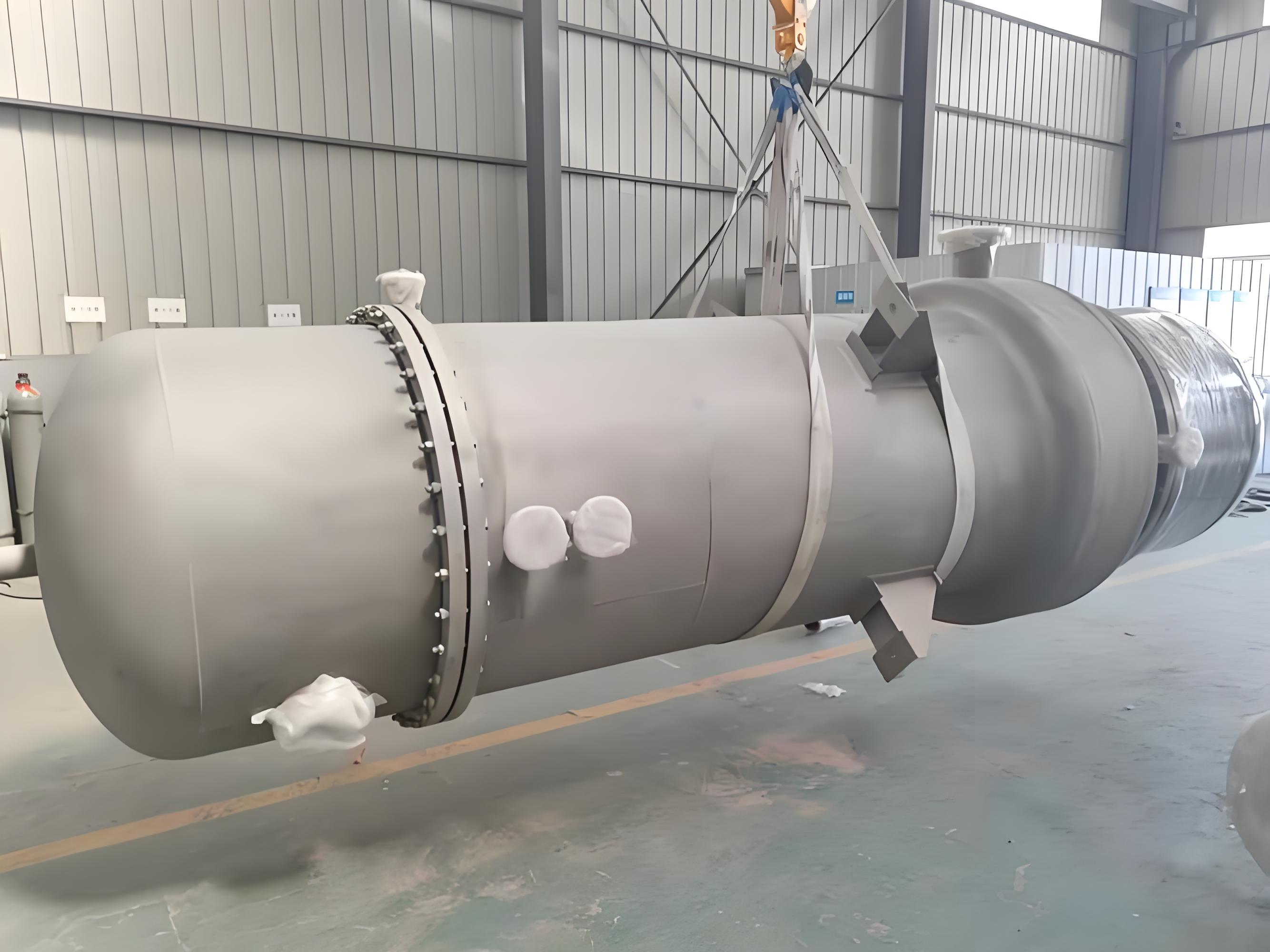
The titanium condenser performs extremely well in dealing with seawater corrosion.
titanium alloy plates have strong corrosion resistance, which is reflected in two aspects: chemical corrosion resistance and electrochemical corrosion resistance. In seawater environment, titanium exhibits strong resistance to corrosion caused by seawater itself, sulfides, chlorides, as well as point corrosion caused by marine organisms and sediments. More notably, titanium can resist accelerated corrosion caused by high-speed seawater and local eddies. This is because the titanium surface can quickly repair damaged protective oxide films, and even in seawater containing sediment and diamond sand with a flow rate of 2m/s, the corrosion rate of the titanium surface is still extremely low.
Based on the characteristic of titanium, a condenser made of titanium can increase the flow rate of seawater. The increase in seawater velocity is beneficial for enhancing heat exchange efficiency, thereby significantly improving cooling effectiveness and ensuring efficient and stable operation of thermal and nuclear power plants. Compared with traditional aluminum brass tube condensers, titanium condensers not only solve the problem of corrosion and leakage, but also provide solid guarantees for the long-term reliable operation of power equipment by optimizing cooling performance.
Titanium blades: lightweight and corrosion-resistant, enhancing the performance of steam turbines
In the field of steam turbines, especially in the last few stages of the low-pressure section, titanium alloy plates also demonstrate excellent application value. Usually, turbine blades are made of martensitic chromium stainless steel, but this steel has many drawbacks. Steel has a high specific gravity, and for high-speed rotating steam turbines, steel blades need to withstand enormous centrifugal forces. At the same time, chlorides and sulfides are often mixed into water vapor due to condenser leaks and other reasons. These media can cause pitting corrosion on the surface of the blades, forming crevice corrosion between the blade root and tip or at the reinforcement, and the corroded area becomes a crack source, seriously affecting the service life of the blades and the operation safety of the steam turbine. In addition, the fatigue performance of Cr13 steel is not ideal, and its fatigue strength significantly decreases in corrosive environments with saturated sodium chloride solution, especially in low pH and oxygen-containing conditions.
In contrast, using titanium blades directly to replace steel blades with their original geometric shape can bring significant improvements. Titanium blades are lightweight, and at the same rotational speed, the centrifugal force acting on the blade root can be reduced by 40%, greatly reducing the stress load on the blades. Moreover, the corrosion resistance of titanium blades to salt containing steam is much better than that of steel blades, and the fatigue performance of titanium alloys is also higher than that of stainless steel. In air, the fatigue strength of Ti-6Al-4V alloy is about 30% higher than that of Cr13 steel; In sodium chloride solution, the fatigue strength of Cr13 steel decreases by 2/3-4/5, while the fatigue performance of titanium alloy is not affected. Therefore, under corrosive conditions, considering the advantages and disadvantages of fatigue performance, replacing steel with titanium has become an important measure to improve the performance of steam turbines.
Titanium protective ring: high-strength non-magnetic, ensuring stable operation of the generator
The retaining ring is a crucial component in the entire turbine generator system. Large generators have extremely strict requirements for retaining rings, requiring high strength, good fracture resistance, insensitivity to stress corrosion cracking in aqueous media, and non-magnetic properties. At present, retaining rings are mostly made of austenitic Fe Mn Cr alloy, but this alloy has obvious defects, a strong tendency towards stress corrosion cracking, and reliability issues in achieving high strength.
The Titanium Alloy Plate protective ring can well meet the various requirements of large generators. The specific strength of the titanium alloy plate protective ring can easily meet the design requirements, and it is non-magnetic and insensitive to stress corrosion. Therefore, using titanium to manufacture the protective ring is an extremely suitable choice. At present, the Soviet Union is in a leading position in this regard, and its successful application has provided valuable reference experience for other countries.
In summary, titanium alloys have been widely used in key components such as condensers, turbine blades, and generator retaining rings in power equipment due to their excellent corrosion resistance, high specific strength, good fatigue performance, and non-magnetic properties. With the continuous advancement of technology and the increasing demand for equipment performance, the application prospects of titanium alloys in the field of power will be even broader, and they are expected to provide strong material support for the stable development of the power industry.